
Repairs & Maintenance Policy
2026 - 2029
Monitoring and review
Document owner |
Approved by |
Authorised by |
Effective date |
Review date |
| Neil Causer, Head of Housing Maintenance | Ian Gardner, Director – Property Services |
Document history
Version |
Summary of changes |
Document status |
Date |
| V1.0 | Draft for internal consultation | Withdrawn | October 2025 |
| V2.0 | Draft for customer consultation | Withdrawn | December 2025 |
| V3.0 | Draft for customer consultation | Live | January 2026 |
1.0 Background
This policy sets out Wolverhampton Homes’ approach to Repairs and Maintenance and how the company will fulfil its responsibilities and duties to ensure the homes and assets, under its management control, remain safe and serviceable for its residents, communities and colleagues.
This policy forms part of a suite of documents that underpins the company’s compliance with the Regulator of Social Housing’s (RSH) Consumer Standards, notably their Safety and Quality Standard, as below:
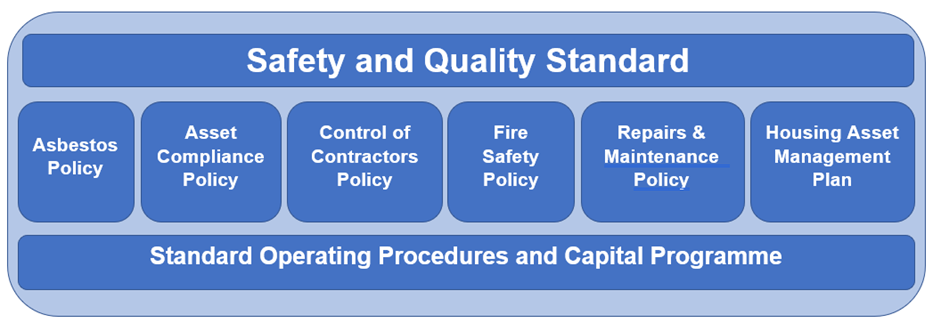
The scope of this policy includes all areas of repairs and maintenance to existing assets and components that are the responsibility of Wolverhampton Homes, under its Management Agreement with the City of Wolverhampton Council, to maintain.
The Housing Asset Management Plan and the City of Wolverhampton Council’s capital investment programmes set out investment priorities, where key components have reached the end of the expected lifecycle and/or are beyond uneconomical repair. In addition, separate programmes or policies may exist where homes or estates require major improvements, upgrading or regeneration.
2.0 Statement of Intent
Wolverhampton Homes considers providing healthy and safe homes for its customers as being paramount and the company takes its responsibilities very seriously. This policy outlines the company’s responsibilities and legal obligations prescribed within the Health and Safety at Work Act 1974, and other relevant regulations and statutory guidance, with the aim of eliminating risks where reasonably practicable and managing any residual risks to all affected persons.
This policy demonstrates the company’s commitment to ensuring compliance with all legal, regulatory and statutory requirements associated with the repairs and maintenance of all homes, communal areas and assets managed by Wolverhampton Homes.
Wolverhampton Homes will make reasonable endeavours to carry out effective repairs at the time agreed with the tenant in a safe and effective manner.
All colleagues and contractors working within the field of repairs and maintenance will be competent to effectively manage and deliver each area of activity within the scope of this policy.
3.0 Scope
This policy sets out how property-related repairs and maintenance service requests, submitted by tenants or colleagues or partners, will be managed to meet statutory and regulatory standards. The policy balances the efficient delivery and maintains value for money to meet the needs of the tenants and ensure homes are appropriately maintained, remain safe, secure and functionable.
The main aims of the policy are to:
- Meet minimum housing standards and regulatory requirements, particularly the Safety and Quality Standard of the RSH’s Regulatory Framework
- Ensure compliance with statutory instruments for housing, including the Landlord and Tenant Act 1985, Social Housing (Regulation) Act 2023, Homes (Fitness for Human Habitation) Act 2018, Hazards in Social Housing (Prescribed Requirements) (England) Regulations 2025 (commonly referred to as Awaab’s Law)
- Maintain properties to the Decent Homes Standard
- Meet contractual requirements set out in the Landlord’s Tenancy Agreement or Lease
- Provide a customer-focused service that balances cost effectiveness and value for money, and eliminates any hazards in the home.
- Undertake major repairs in planned or packaged work to maintain value for money
- Allocate requests for repairs to a category based on information provided by the tenant but reserve the right to amend these at the discretion of Wolverhampton Homes, based on risk assessment
- Set out how Wolverhampton Homes will ensure compliance with the RSH Safety and Quality Standard
4.0 Responsive Repairs Definition
Responsive repairs are defined as service requests made by the tenant relating to existing elements or components of the property (their dwelling or common areas to the block they are residing within). A responsive repair is to undertake a repair or replacement of an existing element or component to return to its original designed purpose or function.
A responsive repair is not an upgrade, renewal or improvement to the property, and therefore not part of:
- Planned cyclic maintenance, for example: lift maintenance, gutter cleaning, electrical testing, gas servicing or cyclical painting
- Planned or batched work, for example: environmental works, paving, guttering or fascia replacements, roofing repairs, or flooring
- Programmed works, for example: replastering, door replacements
- Planned capital improvements, for example: replacement kitchens, bathrooms, rewiring, heating upgrades, or insulation
- Void refurbishments (work to empty homes)
- New aids or adaptation works to support occupants continuing to live in their homes following an assessment by Independent Living Services
- Repairs to assets under the control of others, such as: neighbours, utility providers, statutory authorities
- Surface water drainage
- Garden or grounds maintenance, including landscaping, planting and ground water drainage
- Replacement of components for cosmetic purposes only (subject to the component remaining functional for its intended purpose and creates no safety hazard)
5.0 Requesting Repairs
Tenants will be offered a range of ways to make requests for repairs, including:
Via telephone - calls received outside normal office hours will process emergency service requests only
- Via self-serve on Wolverhampton Homes website
- Via self-serve mobile applications
- Via email
- In writing to Wolverhampton Homes head office
Tenants will be encouraged to use digital channels to make service requests for repairs, however a range of communication methods will be available to meet the needs of our diverse communities.
6.0 Landlord and Tenant Responsibilities
The Landlord and the tenant have different responsibilities in relation to repairs.
The Landlord and Tenant Act 1985 Section 11 (1) states that the Landlord (City of Wolverhampton Council) is responsible for keeping the following in repair and proper working order:
- The structure and exterior of the dwelling and the building containing the dwelling (including drains, gutters and external pipes)
- The installations for the supply of water, gas and electricity and sanitary installations (including basins, baths and toilets)
- The installations for the supply of space heating (that is: gas fires or central heating) and water heating
- Communal areas and common parts, including services and safety systems under the Landlord’s control
Section 11 does not require the landlord to:
- Carry out repairs necessary because the tenant failed to use the property in a tenant-like manner
- Rebuild or reinstate the property after destruction or damage by fire, flood or storms
- Repair or maintain anything the tenant is entitled to remove from the property
It will be communicated to the tenant at the time they request a repair whose responsibility it is, based on the information provided. This is subject to change if the information provided is inaccurate. Repairing responsibility will be determined in accordance with the Tenancy Agreement.
Where a repair is the tenant’s or leaseholder’s responsibility, they may be signposted to the City Council’s Trading Standards Approved Traders schemes.
Any works undertaken would be at the tenant’s own expense. Alternatively, Wolverhampton Homes may undertake the work and recharge the resident in accordance with the Chargeable Works Policy.
Landlord responsibilities include the building structure and elements of the exterior, including common areas, and components that have been installed or are under the control of the Landlord.
The law implies a condition into every Tenancy Agreement that the tenant must use their home in a ‘tenant-like manner’.
Using a home in a tenant-like manner generally means:
- Doing minor repairs
- Keeping their home reasonably clean
- Not causing any damage to the property and making sure their visitors do not cause any damage
- Using any fixtures and fittings properly, for example, not blocking a toilet by flushing something unsuitable down it.
Under their Tenancy Agreement, tenants are responsible for keeping the interior of their homes in good order and well decorated. Tenant responsibilities include items they have installed themselves and completing minor repairs, for example:
- Reglazing windows and doors where damage has not been caused by a crime
- Lock changes when keys are lost or misplaced
- Replacing lost keys and fobs and the cost of getting into their home if they are locked out
- Clearing blockages in the toilet pan or waste traps
- Replacing electric fire elements, fire effect bulbs or gas fire radiants
- Cleaning of chimneys and flues of tenant’s own solid-fuel-burning appliances
- Replacing lamps, bulbs and light fitting starters
- Replacing electrical fuses and the resetting of circuit breakers
- Replacing plugs and chains to waste pipes in sinks or baths
- Replacing shower hose and shower head
- Replacing shower curtain and rail
- Replacing toilet seats
- Replacing clothes lines
- Maintaining the gardens including trees, shrubs and clearing rubbish
- Any repair to installations or improvements tenants have made
- The Council or its agents may repair some gas and electrical appliances for safety reasons but may charge any excess costs over the Landlord’s normal requirements.
- Maintaining internal decoration, including central heating radiators.
- Maintaining electric vehicle chargers installed by the tenant or their agent
- Maintaining appliances provided by the tenant, for example: washing machines, showers, pumps and so on
- Maintaining outbuildings provided by the tenant, for example: sheds, greenhouses, car ports and so on
Where Wolverhampton Homes is required to undertake works that are the tenant’s responsibility, these will be subject to a charge under the Chargeable Works Policy.
The Landlord, via Wolverhampton Homes, will maintain paving from the highway to each main access door (front, side and rear, where applicable) to the property.
Neither Wolverhampton Homes nor the Landlord is responsible to provide, ensure or maintain:
- Assets under the control of others, such as: neighbours, utility providers or telecoms providers, statutory authorities
- TV aerials or signal receiving equipment (unless part of an existing communal system under the control of Wolverhampton Homes)
- Surface water drainage
- Garden or grounds maintenance, including landscaping, planting and ground water drainage
- Electricity, including cost recovery or income, or heat generation provided by solar or ground source technologies provided by the Landlord or others.
Tenants are responsible for maintaining the gardens, including trees (except in circumstances outlined in the Tenancy Agreement), shrubs, garden paths (not providing access to the home), patios and clearing rubbish.
The Landlord is not responsible to provide or maintain fencing between properties. Tenants are responsible, under their Tenancy Agreement, to:
82) You agree not to allow, permit or cause any animal to create a nuisance, annoy or frighten other people. You agree to ensure that any animal is kept under control at all times. You are responsible for providing and maintaining any fencing specifically required for control of the animal at your own expense. Further you agree to pay us or our contractors the cost of any remedial work necessary to fencing as a result of the animal’s behaviour.
The Landlord will maintain fencing that is:
- Adjacent to open land
- Next to a main ‘A’ road
- Bordering a public alleyway, canal or railway embankment
- Adjacent to a garage site or car park
- Bordering communal areas to all flats in a building
- Subject to an existing and up to date Fencing Service Charge
Arrangements where the Landlord may provide discretionary fencing between properties can be found in Appendix A.
Requests for general property improvements, for example, installing additional electric sockets and repairing damage to a property caused by the occupants, will normally be considered as tenant responsibility.
Tenants who wish to make alterations or improvements to their home will normally be required to seek permission from Wolverhampton Homes in advance. Any specialist surveys or inspections that may be required to facilitate a tenant’s own improvement, may be chargeable. The Landlord is not responsible for maintaining or replacing current or former tenants’ own improvements or alterations, examples include kitchens, bathrooms, outbuildings, porches, canopies, lead to glazing, fireplaces, built-in wardrobes, cupboards, solar panels, electric vehicle chargers and so on.
Permissions may be granted subject to conditions or declined. Unauthorised alterations or improvements may be removed or rectified by Wolverhampton Homes and any costs incurred will be recoverable from the tenants.
Where a fault is not an emergency and has occurred as a result of tenant damage, neglect or abuse, the tenants will be required to pay the cost of repair before any work is undertaken.
Tenants are responsible for reporting any repairs, defects, damp, excessive mould or property damage to Wolverhampton Homes as soon as reasonably practicable.
Tenants are responsible for undertaking regular testing of smoke alarms and carbon monoxide detectors within their home and report any faults to Wolverhampton Homes. The Landlord will provide guidance and instruction how to test alarms within their home.
The Landlord is responsible for undertaking maintenance, servicing and inspection of equipment it has installed in its homes and common areas. These include, but are not limited to, gas appliances, smoke or fire detection, fire sprinklers, lifts and hoists, electrical installations and appliances, emergency lighting, water temperature control and so on. Tenants are responsible for co-operating with the Landlord, or its agents, and for providing access, with reasonable notice, to facilitate any inspection and testing required.
Leaseholders have a range of duties and responsibilities under their Lease, including maintaining and servicing appliances at their own cost. They also have a duty to co-operate and provide access to undertake fire safety inspections.
Wolverhampton Homes will respect the tenant's Right to Quiet Enjoyment. Section 9A (8) of the Landlord & Tenant Act 1985 addresses when a landlord or contractor can enter a tenant's home. Unless in the case of an emergency, such as a flood or fire, entry is only permitted at a reasonable time and with at least 24 hours' written notice provided to the tenant. Tenants can request a more convenient appointment but must allow the landlord or contractor access once the appointment is agreed upon. The Right to Quiet Enjoyment is not a right to complete silence or living in a perfectly peaceful neighbourhood.
7.0 Prioritising Repairs and Inspections
Timescales and service standards only apply to repairs under the Landlord’s control, that is: excluding issues relating to private properties that may affect tenants’ homes, neighbours, utility or telecoms providers, statutory authorities and so on.
Wolverhampton Homes will comply with the requirements of the Hazards in Social Housing (Prescribed Requirements) (England) Regulations 2025, commonly referred to as Awaab’s Law, and will:
- Investigate any potential emergency hazards and, if the investigation confirms an ‘emergency hazard’, undertake relevant safety work as soon as reasonably practicable. The investigation and the work will take place within 24 hours of us becoming aware of the hazard
- Investigate any potential significant hazards within ten working days of us becoming aware of them
- Produce a written summary of investigation findings and provide this to the tenant within three working days of the conclusion of the investigation
- Undertake relevant safety work within five working days of the investigation concluding if the investigation identifies a ‘significant hazard’
- Begin, or take steps to begin, any supplementary preventative work to prevent a significant or emergency hazard recurring within five working days of the investigation concluding if the investigation identifies a significant or emergency hazard. If steps cannot be taken to begin work in five working days this will be done as soon as possible, and work must be physically started within 12 weeks
- Satisfactorily complete supplementary preventative works within a reasonable time period
- Consider any vulnerabilities the occupants may have and how these are impacted on by any hazards present and apply any reasonable adjustments to response times or sequence or scopes of work required
- Secure the provision of suitable alternative accommodation for the household, at the social landlord’s expense, if relevant safety work cannot be completed within specified timeframes
- Keep the tenant updated throughout the process and provide information on how to keep safe
For a hazard to be in scope of the Awaab’s Law repair requirements, it must:
- Be a part of buildings or land for which the social landlord is responsible
- Result from defects, disrepair or lack of maintenance
- Be in the landlord’s control to resolve
- Not be damage that is a result of breach of contract by the tenant
- Be a significant or emergency hazard, based on ‘risk to health’, not just that it is present
Requests for repairs that are the Landlord’s responsibility will be prioritised as follows:
Emergency Hazard Repairs
An Emergency Hazard Repair is a repair, based on the information provided and which creates an immediate health and safety risk and/or creates a serious inconvenience to the occupants, neighbours or the public or if serious damage occurring to the property is likely.
Emergency repairs or investigations are attended to within 24 hours, but most service requests will receive a same-day response and will be prioritised based on risk, that is: the impact of the repair on the occupant’s vulnerability.
Emergency repairs include, but are not limited to:
- Extensive visible mould in rooms used for sleeping and/or where occupants have an underlying related vulnerability
- Blocked flues to an open fire or boiler
- Blocked or leaking foul drains or soil pipes
- Broken glass panes breaching security (excluding cracked where safe)
- Burst pipes or water/roof leaks that cannot be reasonably contained or controlled
- Carbon monoxide alarm activations
- Exposed live mains (230V>) electrical wires, connections, fixtures or fittings
- Faulty smoke alarms, detectors, or safety devices
- Gas leaks
- Insecure (non-latchable) windows, doors or locks
- Toilets not flushing, where no other working toilet is available
- Total loss of electricity – excluding network or metering issues not in under Wolverhampton Homes control
- Total loss of heating or hot water (31 October and 01 May, as defined under Right to Repair Regulations)
Wolverhampton Homes may not be able to fully complete an emergency repair at the first visit. The property will be made safe and additional visits may be required. Wolverhampton Homes will advise the tenant of the relevant timescales for any additional visits that may be required, based on the scope of work or materials required.
If the fault is very serious and makes the home uninhabitable (typically affecting two or more habitable rooms) or it creates an emergency hazard, the tenant will be offered temporary accommodation until the property can be made safe.
Significant Hazard Repairs
A Significant Hazard Repair is a repair, based on the information provided and which creates a potential significant health and safety risk to the occupants.
Wolverhampton Homes will conduct a ‘standard investigation’ within 10 working days of becoming aware of a potential hazard. This will confirm whether or not there is a significant or emergency hazard and must also, if possible, identify the required work to make a property safe and prevent the hazard from recurring.
Following the conclusion of an investigation – whether that be standard, emergency, renewed or further investigation – we will produce a written summary of our findings and issue this to the tenant within three working days, unless all required works (both to make the home safe and prevent the problem recurring) have been completed to address any ‘significant’ or ‘emergency’ hazards before the end of the three working day period.
If the investigation concludes there is a significant hazard or an emergency hazard, we will begin relevant works within five working days of the investigation concluding.
There may however be circumstances where it is not reasonably practicable to begin the relevant work within five working days, for example:
- We are unable to secure specialist workers to attend the property within five working days
- We are unable to secure the required materials for relevant supplementary preventative work within five working days
- We are unable to secure required approvals, for example, from local authority building control or Building Safety Regulator, within five working days
- We are unable to contract necessary detailed surveys or assessments, such as a fire risk assessment of external walls or a structural survey, within five working days
In these circumstances, we make our best endeavours to commence the relevant supplementary preventative work as soon as reasonably practicable and within 12 weeks.
8.0 Right to Repair (Urgent Repairs)
Wolverhampton Homes will meet its legal requirements under the Right to Repair.
The Secure Tenants of Local Housing Authorities (Right to Repair) Regulations 1994 gives the right to tenants to have urgent repairs carried out with prescribed timescales. Wolverhampton Homes will make reasonable endeavours to complete works within the relevant statutory timescales, as set out in Appendix B.
9.0 Reports of Damp, condensation and/or Mould (DMC)
Homes can experience dampness and/or condensation for a range of reasons, including building defects, such as leaking pipes or roofs; poor construction design, such as concrete construction or low levels of insulation; inadequate heating and/or ventilation; or high internal humidity levels. These scenarios can create environments that exacerbate condensation forming and mould spores to grow.
Wolverhampton Homes adopts a ‘fabric first approach’ and initially assumes reports of dampness, water penetration and/or mould growth relate to a property-related defect.
Where tenants report dampness, water penetration and/or mould growth, and where this is considered to be a potential ‘significant hazard’, an investigation by a competent person will be undertaken within ten working days.
A DMC risk assessment will be undertaken at the initial point of contact by a competent person. Timescales for rectifying traumatic damp and mould will be evaluated and prioritised according to the evidence of DMC and consideration of any customer vulnerabilities. Wolverhampton Homes will make all reasonable endeavours to abate the hazard and undertake any remedial works in accordance with Awaab’s Law.
A competent person may also provide the tenant with advice to minimise the effects of condensation, where appropriate.
Works identified as DMC ‘root-cause’ related, will be raised against the appropriate routine or programme activity timescales. These estimated timescales and a summary of the works to be undertaken will be conveyed to the customer within three working days of the completion of the DMC investigation.
Condensation within double glazing units will be processed as a routine repair because this does not constitute an emergency or significant hazard.
Wolverhampton Homes will be proactive and take reasonable steps to prevent internal atmospheres occurring that propagate mould growth through its use of materials and specifications and by analysing property data and patterns of service requests.
Colleagues and contractors will also be encouraged to look for signs of dampness, water penetration and/or mould growth when undertaking home visits, for any reason, and report these to Wolverhampton Homes for action.
Wolverhampton Homes will use data from contacts, in-home monitoring sensors, service requests, repairs activity, complaints and stock condition information to inform future planned investment programmes.
Where homes are identified for planned investment programmes or disposal, Wolverhampton Homes will closely liaise with the tenants to ensure their home remains safe and habitable. Wolverhampton Homes will continue to undertake essential repairs and maintenance, based on the individual needs of the occupants. Temporary repairs may be undertaken prior to the major improvements or rehousing of the tenants occurring, where appropriate.
Wolverhampton Homes will use appropriately trained and competent colleagues to record and investigate reports of dampness, water penetration and/or mould growth, schedule remedial works or provide appropriate advice to tenants. Wolverhampton Homes may utilise external independent specialists to investigate or arbitrate, where appropriate.
Wolverhampton Homes will regularly communicate with tenants to raise awareness of the effects and causes of dampness, water penetration and/or mould growth and provide advice and guidance reduce occurrences. Wolverhampton Homes will support tenants by providing specialist advice or connecting them to appropriate support networks.
10.0 Window Opening Restrictors
Wolverhampton Homes will respond to reports of faulty existing window opening restrictors, to windows above ground floor, as an urgent repair under the Right to Repair Regulations, which means it will be actioned within one working day.
Requests from tenants or leaseholders to install new or additional window opening restrictors will be processed as a routine repair.
Wolverhampton Homes will regularly communicate with residents to raise awareness of the hazards of persons falling from unrestricted or unlatched windows.
11.0 Routine Repairs
Routine repairs are day-to-day repairs that do not present an emergency or significant hazard for the occupants and is a repair or replacement to an existing element or component, to return to its original designed purpose or function.
Routine repairs are normally completed within 20 working days, however parts availability or specialist surveys, for example, intrusive, drainage, asbestos, being required may extend these timescales for operational reasons. Tenants will be kept updated with progress and where timescales may vary for technical reasons.
Routine repairs do not include any emergency or significant hazards, but may include the following:
- Cracked glass or misted/condensed double glazed units
- Faulty doors and windows
- Faulty electrical fittings and appliances
- Faulty garage doors
- Faulty internal joinery and stairs
- Faulty kitchen unit doors or drawers
- Minor leaks to sanitary ware, water or waste systems
- Minor repairs to uneven paving/slabs
- Pest infestation (where landlord’s responsibility only)
- Plaster patches (typically less than one square metre)
- Repairs to fencing and gates, to open land or subject to an existing and up to date service charge
- Replacing parts after gas appliance servicing, where not the primary heat source
- Replacing toilet pans or cisterns
- Replacing wash hand basins
Wolverhampton Homes aims to complete all routine repairs within 20 working days by a pre-agreed appointment. These repairs will normally be started and completed the same working day. However, on occasions, additional visits may be required. Wolverhampton Homes will advise tenants of the relevant timescales for any additional visits that may be required, based on the scope of work or materials required.
12.0 Non-Urgent Repairs
Non-urgent repairs are day-to-day repairs that do not present an emergency or significant hazard or create a significant inconvenience for the occupants and is a repair or isolated replacement to an existing element or component, to return to its original designed purpose or function. Non-urgent repairs include, but are not limited to:
- Any minor works that require asbestos removal
- Minor repairs to guttering and rainwater goods
- Minor repairs to outbuildings or stores
- Plastering to a single wall or ceiling
- Renewing floor tiles
- Renewing stair treads or balustrades
- Replacing a bath or wash hand basin
- Replacing a kitchen single base or wall unit or sink
- Replacing existing thermoplastic floor tiles or vinyl flooring
- Replacing isolated kitchen units or worktops
- Roofing, including chimneys
Wolverhampton Homes aim to complete non-urgent repairs within 90 calendar days from the property inspection.
Components will not be replaced for cosmetic purposes only. Subject to the component remaining functional for its intended purpose and there being no safety hazard, they will remain. Individual replacements of kitchen doors or drawer fronts or tiling may differ in colour from the remaining or adjoining items due to obsolescence. A functional alternative may be installed pending complete renewal under future planned investment works/programmes.
13.0 Programmed Works and Demand-Led Replacement (DLR) Programmes
Some repair requests may identify components that have reached the end of their economic life and require complete renewal. Examples include kitchens, bathrooms, plastering to complete rooms, joinery, heating systems, paving or hard standings and so on.
Programmed works or Demand-Led Replacement (DLR) programmes are larger activities that normally require the complete renewal of existing major components, that do not create an emergency or significant hazard. These will be delivered on a batched and programmed manner to improve communication, efficiency, value for money and workforce planning.
Wolverhampton Homes will complete programmed works or DLR programmes on a rolling programme across the city, with indicative estate-based programmes being made available to customers. Timescales will vary based on work type and approved budgets.
Programmed works include, but are not limited to:
- Any works required to be undertaken by a Licensed Asbestos Contractor
- Enhancements to dwelling ventilation (to reduce effects of condensation)
- Internal wall insulation (to reduce effects of condensation)
- Renewing internal joinery and doors
- Renewing solid or timber suspended floors
- Renewing or upgrading bathrooms suites
- Renewing or upgrading electrical appliances
- Renewing or upgrading kitchens (complete or substantially)
- Renewing or upgrading roof coverings, including chimneys, verges and ridges
- Renewing or upgrading to communal areas or common parts
- Renewing or upgrading to rainwater goods (guttering, downpipes and so on)
- Replastering to walls and/or ceilings
- Specialist access equipment or work at height planning, when required
- Specialist or structural works, when required
- Where Building Control, Building Safety Regulator or planning consent is required
Where tenants have submitted a Right to Buy application, programmed works and any DLR programmes will be suspended, where the works could potentially impact on the property’s valuation. Response repairs to address any emergency or significant hazards will continue.
Statutory repairs subject to the Secure Tenants of Local Housing Authorities (Right to Repair) Regulations 1994 and Hazards in Social Housing (Prescribed Requirements) (England) Regulations 2025 will continue to be actioned.
14.0 Property Inspections and Investigations
Wolverhampton Homes’ aim is to allocate all service requests for response repairs based on the information provided by the tenant at the first point of contact. Most repairs will receive an initial visit from a competent tradesperson or contractor.
Due to the nature of the service request, an inspection by a competent person may be necessary to obtain more information or to undertake a more detailed investigation, identify any hazards, determine the scope of the work and safely plan delivery of the works.
When an inspection is required, and where a significant hazard may be present, an investigation appointment will normally be offered within ten working days.
Routine inspections, such as where there is no suspected emergency or significant hazard being present, an investigation appointment will normally be offered within 20 working days. Where a specialist or external or independent surveyor is required, additional timescales may apply, but we will keep the tenant informed of progress.
Non-emergency repair works orders or instructions for work will not be raised until the inspection or investigation has taken place. Any necessary works will be raised for the appropriate response repair timescales or included in future programmed works or Demand-Led Replacement (DLR) programme.
15.0 Adaptations
When responding to response repair requests, visits by tradespersons and officers may identify a need for the occupants to require potential adaptations to the property for mobility, sensory or safety reasons. Wolverhampton Homes will provide the appropriate contact information to the tenant in order for them to submit a referral directly to the Council’s Independent Living Services team for specialist assessment.
Any non-emergency, programmed and DLR works may be suspended, pending receipt of assessment and any recommendations by the Council’s Independent Living Services team to ensure repairs or improvements meet the needs of the occupants.
16.0 Appointments
Individually agreed appointment timeslots will be offered to tenants for all urgent and routine repairs and inspections or investigations, where access inside or to the rear of the property is required. For communal areas, responsive repairs and external works, where no tenant-controlled access is required, appointments will not normally be made.
Wolverhampton Homes will endeavour to keep all appointments made or give the tenant prior notice if this is not possible and a new appointment will be agreed. Appointments will normally be offered for Monday to Friday (excluding Bank Holidays) for AM, PM, all day or all-day avoiding ‘school run’ slots.
Where appointments need to change due to unforeseen circumstances, Wolverhampton Homes will provide as much notice as reasonably practicable to the tenant. Similarly, if tenants need to change an appointment, Wolverhampton Homes requests as much notice as possible to enable us to make new appointments for other customers. If a pre-arranged appointment is missed due to tenant unavailability or refusal to allow us access, the repair call order will be cancelled, and the tenant will need to contact Wolverhampton Homes for the repair to be rebooked. Rebooked repairs will be treated as a new repair for calculating repairs timescales.
Where the service request may relate to a Category 1 hazard (as defined under the Housing Health & Safety Rating System) or an emergency or significant hazard under Hazards in Social Housing (Prescribed Requirements) (England) Regulations 2025, Wolverhampton Homes will make further access attempts and consider Legal action under its Access to Homes Policy.
17.0 Completion at First Visit and Right First Time Commitments
Wolverhampton Homes is committed to providing value for money services and maximising tenant satisfaction. Wolverhampton Homes is committed to providing a repairs service that completes as many repairs as possible during the first visit to the tenant’s home, wherever possible, and completed works are ‘right first time’, that is: the repair undertaken is of satisfactory quality and free from defects.
Some repairs cannot be completed in one visit for technical reasons, where repairs are adjacent to private properties, requiring scaffold or where specialist equipment or materials may be required, or may be subject to additional timescales or included in future programmed works or planned investment programmes.
Wolverhampton Homes will advise the tenant of the relevant or estimated timescales for any additional visits that may be required, based on the scope of work required.
To manage the quality of repairs, quality inspections, audits or surveys may be undertaken. Tenants can also report concerns or defects to Wolverhampton Homes for further investigation.
The Repairs and Maintenance Policy sets out target timescales for most day-to-day repairs to tenants’ homes. Faults with neighbouring homes, which are not under the management of Wolverhampton Homes, can affect our properties and tenants. In these circumstances, the Landlord’s service standards do not apply, as it is normally the responsibility of the neighbour or their Landlord to resolve any defects. These are commonly leaks affecting the home or garden, but other faults can impact on Wolverhampton Homes’ tenants. Wolverhampton Homes will inform the neighbouring household of the fault and request they complete the repair in a reasonable timeframe, considering the severity and inconvenience the defect may be causing. Wolverhampton Homes will monitor the rectification of the defect and keep any Wolverhampton Homes affected tenants informed of progress and when the repair is likely to be completed by others.
In circumstances where neighbouring households do not respond satisfactorily to Wolverhampton Homes’ requests for action, Wolverhampton Homes will make all reasonable endeavours to resolve the issue affecting the tenants, which may include legal action being taken against the neighbouring owner occupier or Landlord.
Wolverhampton Homes has no right of access to homes not under its management control. If the fault is very serious and makes the home uninhabitable, which is typically affecting two or more habitable rooms, or it creates an emergency hazard, the tenant will be offered temporary accommodation until the property can be made safe.
18.0 Decoration
Internal decoration is normally the tenant’s responsibility. Care will be taken to minimise damage to any decoration resulting from repair work undertaken by Wolverhampton Homes or its contractors. Where decorations have been substantially affected, Wolverhampton Homes will offer either:
- Decoration vouchers for the tenant to purchase materials for their application
- Decoration works to be undertaken by Wolverhampton Homes or their appointed contactor
19.0 Pests and Vermin
As detailed within the Tenancy Agreement, it is the tenant’s responsibility to keep the property in a clean condition including, but not limited to, taking steps to eradicate any pest or vermin infestation within the property (dwelling). The treatment of pests or vermin is therefore not normally considered to be a landlord responsibility under this Policy, unless the property structure is defective. Examples may include a broken drain or gully, crack or hole in walls, missing roof tiles or vent grilles. In these circumstances, we will make good any necessary repairs and arrange pest treatment, if the defect was the probable cause of the infestation.
The original construction methods or design of architectural features may create entry roots for vermin, for example: open roof eaves, joist pockets or perforated sleeper walls. These do not constitute a ‘defect’ and any associated pest control works will be the responsibility the tenant.
20.0 Service Standards
Wolverhampton Homes will:
- Comply with the requirements of the Regulator of Social Housing Consumer Standards
- Attend emergency hazard repairs within 24 hours
- Investigate significant hazard repairs within ten working days
- Commence hazard mitigation works within five working days of investigation, and commence prevention works, where required, within 12 weeks
- Complete routine, non-urgent day-to-day minor repairs or inspect, where applicable, and schedule works within 20 working days of the report
- Where these timescales cannot be met, the customer will be informed with reasons for the delay and any revised estimated timescales
- Provide estimated timescales, where known, for any future programmed works, Demand-Led Replacement or investment programmes determined by Wolverhampton Homes or the City of Wolverhampton Council
21.0 Voids (Empty Homes)
All homes made available for letting, excluding mutual exchanges, will meet the following minimum standards upon possession or within agreed timescales with the incoming tenants.
All homes will be inspected by a competent person to investigate their condition and to schedule and arrange any necessary works. All homes will meet the standards set out in Appendix C, to ensure they are:
- Clean
- Safe (no Category 1 hazards present and relevant safety certificates are available)
- Secure (lockable external doors and latchable windows)
- In a reasonable state of repair
- Have rubbish cleared away, including that in gardens, outbuildings and communal areas
- Have any sheds or outbuildings that are unsafe or in very poor condition removed
22.0 Interdependences and related policies
This policy should be read in conjunction with the following company documents and statutory instruments (see Appendix D).
- Access to Homes Policy
- Asbestos Management Plan
- Asbestos Policy
- Asset Compliance Policy
- Chargeable Works Policy
- Complaints Policy
- Control of Contractors Policy
- Damp, Mould and Condensation (DMC) Management Plan
- Fire Safety Policy
- Health and Safety Policy
- Housing Asset Management Plan
23.0 Monitoring
Exception reporting will be presented to Wolverhampton Homes Board, Senior Management Team, Audit and Business Assurance Committee, and City of Wolverhampton Council, as required.
Performance against the service standards defined within this policy will be reported to tenants via Wolverhampton Homes Annual Report and within the relevant Tenant Satisfaction Measures.
This policy will be regularly reviewed, at intervals no greater than three years and adapted accordingly to respond to future legislative or regulatory changes.
24.0 Equality Analysis
This policy sets out how the company will comply with legislation relating to existing housing repairs, regulatory standards and best practice.
The policy applies equally to all tenants’ homes and communal areas, regardless of the resident’s age, disability, gender reassignment, marriage and civil partnership, pregnancy and maternity, race, religion or belief, sex and sexual orientation.
Property-related risks will consider the vulnerability of the occupants in accordance Housing Health & Safety Rating System.
Due consideration will be given to tenants who require different forms of communication, and we will take account of individual needs and preferences to ensure all tenants have access to our services.
An Equality Analysis was reviewed by the Equalities Forum on 05 February 2026 and the policy was endorsed.
Appendix A
Fencing Protocols
1. The Landlord is not responsible for providing or maintaining fencing between properties. Tenants are responsible, under their Tenancy Agreement, to:
Clause 82) You agree not to allow, permit or cause any animal to create a nuisance, annoy or frighten other people. You agree to ensure that any animal is kept under control at all times. You are responsible for providing and maintaining any fencing specifically required for control of the animal at your own expense. Further you agree to pay us or our contractors the cost of any remedial work necessary to fencing as a result of the animal’s behaviour.
2. The Landlord will maintain fencing that:
- Is adjacent to open land
- Is next to a main ‘A’ road
- Borders a public alleyway, canal or railway embankment
- Is adjacent to a garage site or car park
- Borders communal areas to all flats in a building
- Is subject to an existing and up-to-date Fencing Service Charge (FSC)
3. Arrangements where the Landlord or Wolverhampton Homes may provide discretionary fencing between properties are subject to these protocols.
4. For new fencing installations or replacement between properties, regardless of ownership, Wolverhampton Homes operates a discretionary budget to undertake a limited number of fencing installations, subject to any benefitting tenants contributing via a weekly FSC and any owner-occupiers or third-party Landlords providing a lump sum contribution. The discretionary budget is reviewed annually and will determine the number of new fencing installations or replacements to be available.
5. The FSC is a set charge and is reviewed annually for inflation. The FSC is a fixed amount and does not vary based on the length or height of fence or scope of works undertaken. The FSC continues indefinitely. Wolverhampton Homes will maintain or renew the fence, as required, where the FSC continues to be paid and is not subject to arrears.
6. The FSC applies to all new fencing installations or replacements, excluding fencing that:
- Is adjacent to open land
- Is next to a main ‘A’ road
- Borders a public alleyway, canal or railway embankment
- Is adjacent to a garage site or car park
- Borders communal areas to all flats in a building
- Is subject to an existing and up-to-date Fencing Service Charge
7. The FSC is applied to all properties that benefit from the erected fence.
8. Exceptional circumstances may apply where Wolverhampton Homes is liable to provide a fence or barrier due to specific health & safety issues, such as falls from height. These cases will be assessed on a case-by-case basis and the implementation of the FSC charge will be at the Director of Housing Operations’ discretion.
9. The implementation of the charge is activated if the total fencing/boundary works sum is £500 or more.
Repairs to Existing Fencing subject to the FSC
10.Wolverhampton Homes will undertake repairs to, or replacement of, existing fencing, where the FSC continues to be paid and is not subject to arrears.
11. Fencing will be repaired, where possible, and only replaced if substantially defective. Individual panels may be replaced, where required, therefore resulting in different style or aged panels or boards in the same fencing line being present.
12. Where fencing has been damaged due to deliberate or negligent acts, repairs may be subject to an additional recharge to the tenant(s) or owner occupiers, subject to the Chargeable Works Policy.
Requests for new Fencing under the FSC
13. Fencing requests, where a Wolverhampton Homes property adjoins an owner-occupier property and a Wolverhampton Homes property that is not subject to an existing FSC, will be processed as the sale/property deeds specify and any defined responsibility split contribution from the owner-occupier will be collected before the works commence.
14.These protocols providing fencing to owner-occupier boundaries also apply to leaseholder-tenant boundaries. Where the boundary adjoins two leaseholder properties and Wolverhampton Homes has no obligation to provide a fence, then the required work should be sourced by the respective leaseholders, with no interest from Wolverhampton Homes.
15. Where there is an obligation for Wolverhampton Homes to provide a fence to a Leaseholder boundary that does not adjoin a Council property, then the cost of the fence shall be recovered from the Leaseholder as outlined in the sale deeds, subject to Section 20 consultation.
16. Where tenants have erected their own fence, such fencing should be left in-situ where it is safe and of a satisfactory standard and where it reflects the boundary line.
17. Where tenants request to have their own fencing replaced by Wolverhampton Homes, they will become subject to the FSC (subject to budget availability).
18. No compensation for any remaining life of the previous tenant’s fence will be paid by Wolverhampton Homes.
19. All tenants who have new fencing or repairs to existing fencing costing £500 or more, will be subject to the FSC.
20. The FSC will not apply to medium or high-rise flats where the fencing forms the perimeter of the block, or low-rise blocks with no designated gardens and these properties.
21. The removal of obstacles, rubbish or shrubbery from the existing garden and any ‘no man’s land’ to facilitate the installation or repair of a fence under the FSC is the responsibility of the tenant and/or owner-occupier.
22. Should the tenant and/or owner-occupier or third parties not undertake the required preparation/clearance works, Wolverhampton Homes may undertake the ground preparation works under exceptional circumstances. That may be subject to an additional recharge to the tenant(s) or owner occupiers, subject to the Chargeable Works Policy.
23. If it is deemed that a fence requires replacing, but both tenants do not wish to participate in the FSC or wait for any future budget availability and agree to carry out the replacement and arrange it themselves, then they have the option to do so.
24. Both tenants are required to agree to the FSC, for fencing works to be undertaken. Should one or more tenants not agree to the FSC, then no works will be undertaken and the boundary should be maintained by the tenants in accordance with their Tenancy Agreement.
25. Any works to boundary fencing should seek to reinstate the fence on the original line as defined on the GIS, where financially viable. If the original boundary line cannot be attained, then consultation with House Sales should be sought on where the new boundary can be located. Following the installation, Wolverhampton Homes will not carry out any alterations works should there be any dispute on the attained boundary line.
26. Wolverhampton Homes will not recommend the replacement of fencing or removal of existing boundaries if they are:
- Safe
- Secure
- Have at least an estimated 18 months’ life remaining
Owner-Occupiers
27. In order to facilitate works to fences that adjoin owner-occupiers, Wolverhampton Homes will seek to recover 50% of the costs from the owner-occupier by issuing a ‘Precedent Letter – Party Walls, Fences and Hedges’.
28. Wolverhampton Homes assumes all boundaries to be party. It is for the owner-occupier to provide evidence of the covenant to prove the contrary. NB: even if recommended by Wolverhampton Homes, there is no right to remove a fence or hedge if it belongs to the owner-occupier and is not presenting a health and safety risk to the tenant.
29. Where remaining life is estimated to be more than 18 months, the boundary should remain for owner-occupier and tenant to maintain.
30. The responsibility for removing foliage, rubbish from their existing garden and any ‘no man’s land’ territory is the responsibility of the owner-occupier. Should the owner-occupier or third parties not undertake the required preparation/clearance works, Wolverhampton Homes may undertake the ground preparation works under exceptional circumstances. That will be subject to an additional recharge to the owner occupier, subject to the Chargeable Works Policy, being paid in advance.
31. Consultation with owner-occupiers should take place prior to works starting to inform them of proposed works and ensure the new fence is erected on the correct boundary line. The Fencing Approval Form must be signed by the owner-occupier prior to works commencing. Small scale works of less than £500 will not require the completion of the form.
32. This Protocol only applies to the installation of Wolverhampton Homes standard specification fencing. Any deviation at the owner-occupier’s request must have consent from the Repairs Manager and will be solely funded by the owner-occupier.
33. Owner-occupiers have the right to opt out of the scheme and install their own fences. Wolverhampton Homes cannot enforce a specification of fencing for joint boundaries, such as height and fencing material or However, what is being proposed must constitute a reasonable boundary in legal terms, be installed to a reasonable standard and be safe.
34. Where acceptance has not been made and/or the standard of fencing is deemed inadequate or of poor quality or workmanship, legal advice shall be sought regarding a remedy.
35. Any new fence shall be deemed a gift to the owner-occupier and Wolverhampton Homes accepts no future responsibility for repairs, maintenance or replacement of the fence.
36. Wolverhampton Homes deems that the Party Wall Act 1996 does not apply to fencing works, as stated in the Party Wall Act Guidance Notes on wooden fences. Consent to the works will be attained from the owner-occupier via the Fencing Approval Form.
Financial Contributions from Wolverhampton Homes to Owner-Occupiers
37. Owner-occupiers may decide to accept the standard of any fencing offered as specified by Wolverhampton Homes, but they may wish to either install fencing themselves or use their own contractor to do so. For Wolverhampton Homes to agree to contribute (up to 50% of the replacement fencing cost), the owner-occupier must obtain and provide three independent contractor quotations.
38. Wolverhampton Homes may contribute up to 50% of the replacement fencing cost based on the lowest priced quote, subject to the specification not exceeding Wolverhampton Homes’ standard fencing specification.
Part Fencing
39. These protocols apply to part fencing, that is: where it is only essential that only part of a fencing run to be replaced.
Recovery of cost from Third Parties
40. These protocols apply to cost recovery from third parties, including utility companies, highways agencies and so on.
Fencing Approval Form
I, the owner (name)…………………of (address)…............................................................................................................. consent
to the fencing works outlined in this letter and agree to the attached stated conditions, including boundaries and costs.
Signed Print name Date
The completed form will be collected in person by the Wolverhampton Homes designated officer.
Wolverhampton Homes contact officer details;
Name………………………………………………………
Telephone…………………………………………………
Email………………………………………………………
Appendix B
Right to Repair (statutory timescales)
Qualifying repairs and timescales are set out in the table below.
|
Repairs type
|
Prescribed period (in working days) |
|
Total loss of electric power |
1 |
|
Partial loss of electric power |
3 |
|
Unsafe power or lighting socket, or electrical fitting |
1 |
|
Total loss of water supply |
1 |
|
Partial loss of water supply |
3 |
|
Total or partial loss of gas supply |
1 |
|
Blocked flue to open fire or boiler |
1 |
|
Total or partial loss of space or water heating between 31 October and 01 May |
1 |
|
Total or partial loss of space or water heating between 30 April and 01 November |
3 |
|
Blocked or leaking foul drain, soil stack, or (where there is no other working toilet in the dwelling-house) toilet pan |
1 |
|
Toilet not flushing (where there is no other working toilet in the dwelling-house) |
1 |
|
Blocked sink, bath or basin |
3 |
|
Tap which cannot be turned |
3 |
|
Leaking from water or heating pipe, tank or cistern |
1 |
|
Leaking roof |
7 |
|
Insecure external window, door or lock |
1 |
|
Loose or detached banister or handrail |
3 |
|
Rotten timber flooring or stair tread |
3 |
|
Door Entryphone not working |
7 |
|
Mechanical extractor fan in internal kitchen or bathroom not working |
7 |
Extract from; https://www.legislation.gov.uk/uksi/1994/133/made
Appendix C
Empty Homes (Void) Standard
All new homes, excluding mutual exchanges, will meet the following minimum standards upon possession or within agreed timescales with the incoming tenants.
The property will be reasonably clean.
Wolverhampton Homes will:
- Clear away any rubbish, including that in gardens, outbuildings and communal areas. During periods of inclement weather this may be undertaken after the tenant has taken moved in
- Remove any sheds or outbuildings that are unsafe or in very poor condition
- Sweep all floors
- Wipe sinks, toilets, baths and wash basins
The property will be safe.
Wolverhampton Homes will:
- Assess for the presence of asbestos and take action to remove it or manage its condition in accordance with current regulations
- Complete gas, where applicable, and electrical safety inspections and provide a copy of the safety certificates to the incoming tenant
- Ensure existing patios, driveways or paths to gardens are free from trip significant hazards or are removed. Please note: paved areas not within the Landlord’s repair responsibilities may be gifted to the tenant or removed
- Ensure internal doors latch shut
- Ensure there are no visible signs of infestation and undertake treatment where appropriate
- Ensure there is satisfactory paving from the public highway to external doors
- Inspect all window opening restrictors, including repairing any defective window restrictors, and/or install new window restrictors on or above the first floor, where they are not present
- Remedy any identified leaks
- Remove alterations or fixtures and fittings that may pose a significant health and safety risk
- Remove or drain garden ponds, unless there is an environmental need to keep them or the incoming tenant specifically requests they remain
- Remove polystyrene ceiling tiles
- Renew internal lead water distribution pipes
- Repair or replace missing or damaged handrails
- Repair or replace missing or unsafe flooring and floor treads on stairs
- Replace missing or damaged glazing. Some cracked glass or misted double glazed units may be undertaken after the tenant has moved in
- Treat any areas of mould growth to the structure/fabric of the building under the Landlord’s control
- Treat and / or seal any areas of internal flaking paintwork to wood or metal if likely applied before 1992, which has a risk of containing lead
- Undertake plaster patching, where necessary
The property will be secure.
Wolverhampton Homes will:
- Ensure any existing rear or side gates are safe and securable with a bolt
- Change main entrance door locks, where possible, and provide at least two keys for all locks, including any lockable windows
- Ensure a carbon monoxide alarm is located in any room used as living accommodation that contains a fixed combustion appliance (excluding gas cookers).
- Ensure at least one smoke alarm is located on each storey of the home, where there is a room used as living accommodation
- Repairs to fencing that forms a boundary between the property and open land, such as railway lines or canals. Unsafe boundary fencing or gates between homes may be removed and not replaced. Please refer to Wolverhampton Homes Fencing Protocols
The property will be in a reasonable state of repair.
Wolverhampton Homes will:
- Ensure all plumbing is working correctly
- Ensure any gardens are provided in a reasonably tidy condition, that is: overgrown gardens are cut back to within 100mm and cleared to enable maintenance with common domestic garden tools/equipment. During periods of inclement weather this may be undertaken after the tenant has taken occupation
- Ensure doors and windows open and close correctly
- Ensure gullies and drain grids are clean and free from obstruction
- Ensure kitchen and bathroom fittings are serviceable and fit for purpose
- Ensure that the property is wind and weather tight
- Ensure that there is a gas and/or electrical cooker supply
- Ensure visible plaster work is in a serviceable condition and can accept decoration, such as wallpaper
- Explain how to operate the heating system, upon occupation
- Maintain washable floor coverings in kitchens and bathrooms, if already provided
- Supply washer connections and locations for washing machines, where reasonably practicable
Please note: components will not be replaced for cosmetic purposes only, subject to the component remaining functional for its intended purpose and creates no safety hazard. Individual replacement kitchen doors, drawer fronts or tiling may differ in colour from the remaining, due to obsolescence, pending future renewal under planned investment works.
Appendix D
Statutory Instruments relating to this policy
Include, but are not limited to);
- Building Act 1984
- Building Regulations 2010
- Construction (Design and Management) Regulations 2015
- Control of Asbestos Regulations 2012
- Defective Premises Act 1972
- Electricity at Work Act 1989
- Environmental Protection Act 1990
- Fire Safety Act 2021
- Gas Safety (Installation and Use) Regulations 1998
- Hazards in Social Housing (Prescribed Requirements) (England) Regulations 2025
- Health and Safety at Work Act 1974
- Homes (Fitness for Human Habitation) Act 2018
- Housing Act 2004 – Housing Health & Safety Rating System
- Landlord & Tenant Act 1985
- Lifting Operations and Lifting Equipment regulations 1998
- Management of Health and Safety at Work Regulations 1999
- Occupiers Liability Act 1984
- Regulatory Reform (Fire Safety) Order 2005
- Safety and Quality Standard
- Secure Tenants of Local Housing Authorities (Right to Repair) Regulations 1994
- Smoke and Carbon Monoxide Alarm (Amendment) Regulations 2022
- Social Housing (Regulation) Act 2023